01
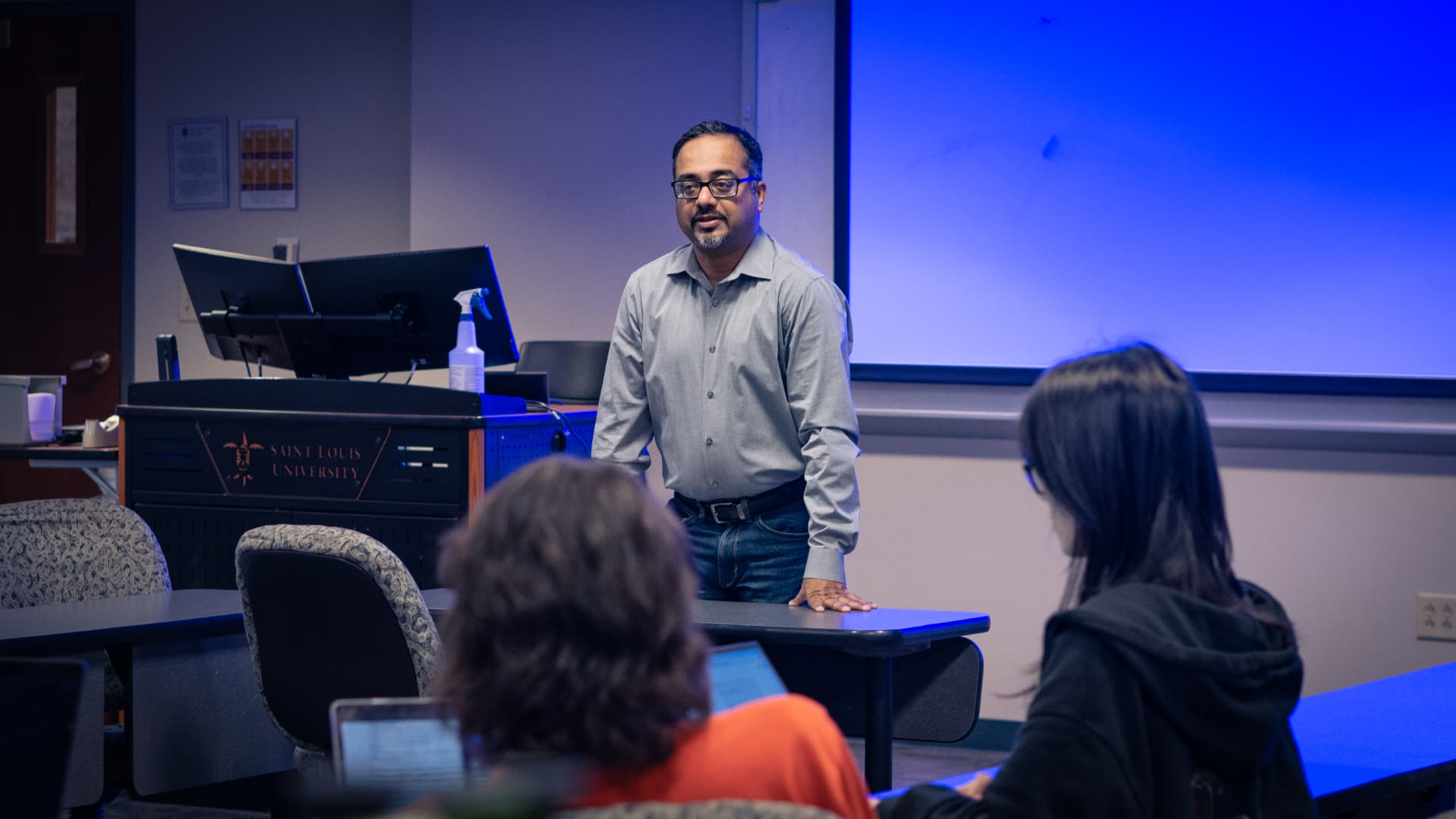
Classroom Engagement
How technology, behavioral design, and thoughtful classroom systems can raise meaningful participation — not just attendance.
Research
My work asks how artificial intelligence and educational technology can increase classroom engagement, strengthen student learning, and preserve meaningful assessment in an AI-enabled world.
How technology, behavioral design, and thoughtful classroom systems can raise meaningful participation — not just attendance.
Adaptive practice, simulation, experiential work, and learning analytics that help students apply concepts to real decisions.
When generative AI can write the assignment, verification of genuine understanding has to be designed into assessment itself.
Method
Design-based research: intervene in a real classroom, observe what breaks, revise. The tool is how the question gets tested.
Educational problem
Something visibly not working in a live course.
Research question
Framed so an answer could change practice.
Prototype
Built small enough to be wrong cheaply.
Classroom implementation
Deployed with real students and real stakes.
Evidence & feedback
What students did, not what they said they would do.
Iteration
Revise, discard, or generalize.
What I am trying to change
Not because education is failing, but because several of its defaults were designed for conditions that no longer hold.
Passive lecture halls
Participation designed into the session
The same four students answering
Channels that lower the cost of speaking
Feedback three weeks later
Feedback in three minutes
One-size-fits-all practice
Adaptive practice tied to what a student missed
Assessment built for a pre-AI world
Assessment that evidences individual reasoning
Policing AI use
Redesigning the task so outsourcing defeats the point
Doctoral research
My Ph.D. at Ghent University (2023), supervised by Prof. Geert Poels and Prof. Palash Bera, asked a deceptively simple question: how can conceptual models fix requirements engineering problems in agile software development without violating agile values?
Agile teams document requirements as user stories — short, user-perspective sentences. On a real project there are hundreds of them, and they are often the only documentation the team has. Past a certain volume, no one can hold the system, its features, and their dependencies in their head. A literature review and interviews with agile practitioners confirmed the pattern: the recurring failures cluster around communication and shared understanding, not around coding.
Conceptual models solve that problem in other settings, but drawing them by hand costs exactly the effort agile teams refuse to spend. So the dissertation removed the cost. I designed an agent-based framework that interprets a set of related user stories written as Behavior-Driven Development (BDD) scenarios, converts them into a structured intermediate representation, and applies a set of mapping rules — implemented as algorithms — to produce four conceptual models automatically: a domain model, a use case model, a process model, and a state machine.
A natural language processing tool automates the whole text-to-model path: feed it BDD scenarios, get the four models back. The approach and the tool were then evaluated through interviews with agile experts. The conclusion: the documentation burden that keeps models out of agile projects is an artifact of manual effort, and once generation is automated, the models earn their place.
The instinct behind this work is the same one that drives my classroom research — find where practice actually breaks down, then build the thing that fixes it and test it with the people who live in that practice.
The six stages
Models generated automatically
Ghent University · Faculty of Economics and Business Administration · Doctor in Business Economics, 2023
Peer-reviewed work
My doctoral research at Ghent University examined how conceptual models can address requirements engineering problems in agile software development — the same instinct applied to a different domain: find where practice breaks down, then build something that fixes it.
Source: Google Scholar
Gupta, A., Poels, G., & Bera, P. · IEEE Access, 10, 119745–119766
Gupta, A., Poels, G., & Bera, P. · Data & Knowledge Engineering, 145, 102141
Gupta, A., Poels, G., & Bera, P. · International Conference on Conceptual Modeling (ER), 47–57
Gupta, A. · REFSQ Workshops
Gupta, A., Poels, G., & Bera, P. · 17th AIS SIGSAND Symposium
Gupta, A., Poels, G., & Bera, P. · 18th AIS SIGSAND Symposium
Bera, P., & Gupta, A. · RADAR+EMISA @ CAiSE, 113–121
Gupta, A., & Poels, G. · 1st International Workshop on Agile Methods for Information Systems
Bera, P., & Gupta, A. · IEEE/ACM 6th International Workshop on Requirements Engineering and Testing
Gupta, A., Poels, G., & Bera, P. · Research agenda
Gupta, A. · Doctoral dissertation, Ghent University
Braverman, E. R., Makale, M., Gupta, A., Graham, B., & Roy, A. K. · USG Proceedings Journal, 1(1), 1–11
Gupta, A., Poels, G., & Bera, P. · Working paper, SSRN
Next
Every question above has something built against it. See the experiments.